
Klik her for at læse mere om projektet og tilmelding.
What Does Your Dog Do When It’s home alone? – Participants Wanted for a New Research Project
Most dog owners occasionally need to leave their dogs home alone, and there are many ways of managing this. Some dogs have access to the entire home, others are confined to a single room, and some are kept in various types of crates.
There is currently limited knowledge about how dogs experience and cope with these different “home-alone” situations, which forms the basis of this research project.
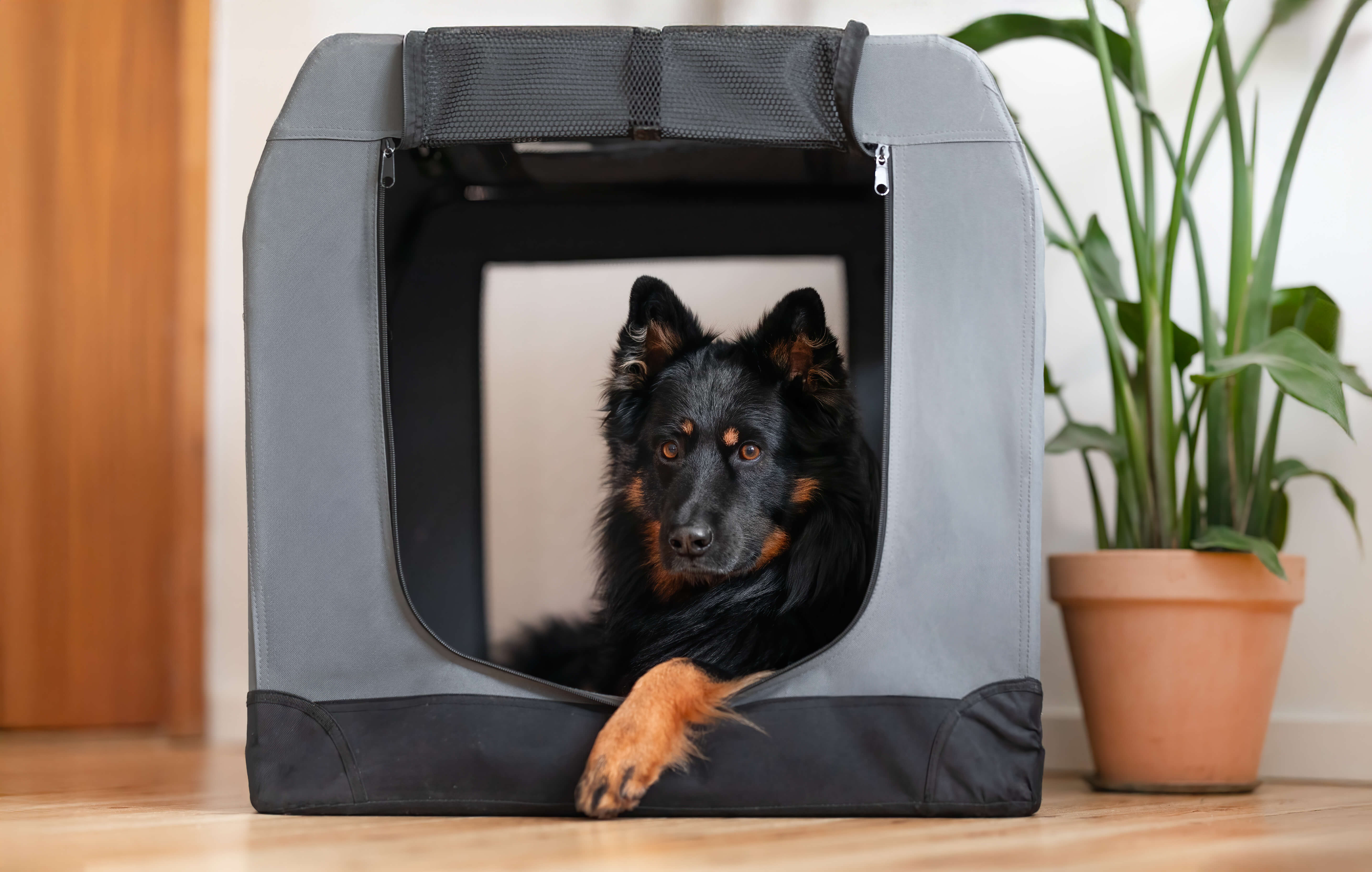
In this project, we investigate dogs’ behaviour when they are left alone at home, based on video recordings provided by dog owners. We are therefore seeking participants who are willing to submit recordings of their dog while it is home alone. Recordings should be made on two separate days and must each last at least one hour. All dogs are eligible to participate, regardless of breed, sex, or age. All recordings and associated data will be treated confidentially and anonymised before being used for scientific purposes.
- The aim is to increase our understanding of canine behaviour, improve dog welfare, and strengthen the relationship between dogs and their owners.
- The project neither promotes nor criticises any method of leaving dogs home alone but takes a neutral position.
- As a participant, you may request an analysis of your dog’s behaviour based on the submitted video material, enabling you to better understand and optimise your dog’s home-alone situation.
You can sign up here or read more about the project below.
The use of crates for dogs has changed in recent years. Previously used primarily in specific situations such as transport, competitions, or illness, crates have increasingly become part of everyday life for family dogs and are often recommended by canine professionals. There are both proponents and critics of crate use. Supporters emphasise the crate as a safe and secure space that dogs often seek out voluntarily, while critics view it as an unnecessary restriction on the dog’s freedom of movement.
At present, there are very few published scientific studies on this topic. However, in 2025, two veterinary students conducted a survey among Danish dog owners as part of their master’s thesis. Approximately one quarter of the nearly 2,500 respondents reported using a crate when leaving their dog home alone. This finding prompted further investigation and forms the foundation of the present project, which is funded by the Danish research centre: Centre for Companion Animal Welfare. The results of the master’s thesis were published in the Journal of the Danish Veterinary Association. The paper is in Danish but includes an English summary and can be found here.
The purpose of the present project is to observe and compare dogs’ behavioural responses when left alone under different conditions. We aim to study dogs with full or partial access to the home without a crate, as well as dogs kept in crates with either an open or closed door. The results will contribute to a better understanding of how physical environments influence canine behaviour.
The project is based on video recordings of dogs in their familiar home environment. Participating dog owners are asked to record their dog while it is alone at home for a minimum of one hour on two separate days. Recordings may be made using a mobile phone, computer, or camera and subsequently uploaded to a secure drive at the University of Copenhagen.
All data will be anonymised and stored in accordance with current GDPR regulations. Detailed instructions for both recording and uploading will be provided upon enrolment.
Once the recordings have been uploaded, they will be analysed and different types of behaviour will be systematically coded. Participants have the option to receive an analysis of their dog’s behaviour based on the submitted material, helping them to better understand and improve their dog’s home-alone experience.
All dogs are eligible to take part. There are no restrictions regarding age, sex, or breed. If you have more than one dog, you are also welcome to participate.
Associate Professor, Veterinarian: Helle Friis Proschowsky hfp@sund.ku.dk
Professor, Veterinarian: Irena Czycholl ic@sund.ku.dk
Master’s thesis student: Trine Jul Dreisig tjd@sund.ku.dk